
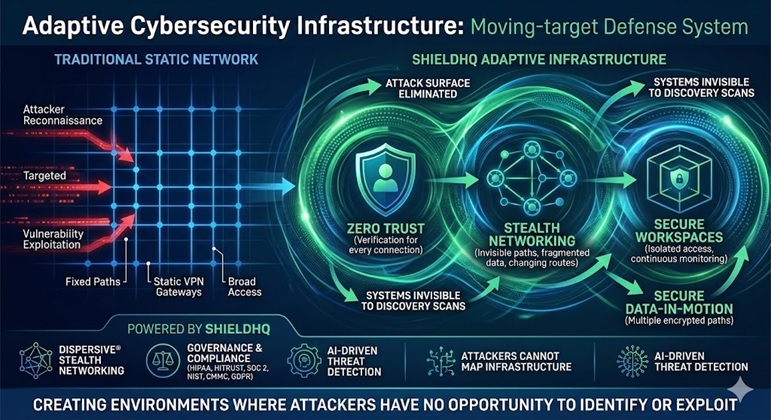
Enterprise cybersecurity has historically been built on static defenses. Organizations deployed firewalls, endpoint protection tools, and intrusion detection systems designed to block threats and monitor activity.
However, today’s cyber attackers operate differently. Instead of launching immediate attacks, many adversaries begin by quietly mapping infrastructure, identifying exposed systems, and exploiting identity weaknesses before moving laterally through environments.
This shift has made traditional security models far less effective. When networks remain static and predictable, attackers have time to analyze them.
Modern cybersecurity strategies are now shifting toward adaptive infrastructure , where systems constantly change and reduce opportunities for attackers to discover vulnerabilities.
Platforms designed around secure workspaces, Zero Trust architecture , and invisible networking technologies are leading this transformation.
Why Static Infrastructure Creates Cyber Risk
Many legacy enterprise networks were designed for accessibility and stability. While this approach helped organizations operate efficiently, it also created predictable infrastructure patterns.
Common weaknesses in traditional environments include:
- Fixed network paths that attackers can analyze
- Static VPN gateways exposing internal systems
- Broad user access after authentication
- Limited segmentation between critical workloads
- Infrastructure visible to discovery scans
When attackers obtain valid credentials, they may be able to explore networks and escalate privileges without immediate detection.
This is one of the main reasons ransomware attacks can spread rapidly across enterprise environments.
To reduce these risks, organizations are increasingly adopting dynamic security models.
The Foundation: Zero Trust Security Architecture
Zero Trust architecture is now widely recognized as a core framework for modern cybersecurity.
Rather than assuming that users inside the network are safe, Zero Trust requires verification for every connection.
Key elements of Zero Trust include:
- Identity verification for every access request
- Role-based permissions limiting system access
- Continuous monitoring of user activity
- Segmentation of sensitive infrastructure
- Secure access for remote employees and vendors
This framework dramatically reduces the ability of attackers to move through systems if credentials are compromised.
However, modern cybersecurity strategies are now evolving beyond access control alone.
Moving-Target Cyber Defense
One of the most powerful concepts in modern cyber defense is moving-target security . Instead of maintaining fixed network structures, infrastructure dynamically shifts communication paths, encryption keys, and access states.
This constantly changing environment makes it extremely difficult for attackers to map systems or exploit vulnerabilities.
Technologies that enable moving-target defense include:
- Dynamic encryption key rotation
- Randomized network path selection
- Ephemeral user sessions
- Fragmented data transmission
- Adaptive access policies
When infrastructure continuously changes, attackers cannot rely on reconnaissance to plan attacks.
Invisible Networking and Data-in-Motion Protection
Protecting data while it travels between systems is another critical aspect of adaptive cybersecurity.
Traditional networks often transmit information through predictable routes, which attackers may monitor or analyze.
Advanced stealth networking technologies address this challenge by dispersing data across multiple encrypted paths.
ShieldHQ leverages Dispersive® Stealth Networking , which fragments and distributes traffic across independent routes so that no single path contains complete information.
This architecture provides several key advantages:
- Network paths remain hidden from discovery
- Data traffic cannot be reconstructed if intercepted
- Infrastructure mapping becomes extremely difficult
- Communication routes change continuously
- Attack surfaces are significantly reduced
By making data-in-motion invisible to attackers, organizations can protect sensitive communications across distributed environments.
How ShieldHQ Implements Adaptive Security
ShieldHQ is designed as a unified cybersecurity platform that integrates several advanced technologies into a single secure environment.
The platform combines:
- Secure cloud workspaces
- Zero Trust identity-based access
- Automated compliance governance
- Continuous monitoring and AI-driven threat detection
- Stealth networking powered by Dispersive®
Rather than exposing internal networks through traditional VPN connections, ShieldHQ allows users to interact with applications through isolated secure workspace environments.
This architecture helps eliminate exposed attack surfaces while maintaining secure access for employees and partners.
ShieldHQ is built to create an environment that is effectively invisible to attackers while maintaining full operational control for organizations.
Compliance and Governance Integration
Security infrastructure must also support regulatory compliance.
Organizations handling sensitive information must comply with frameworks such as:
- HIPAA and HITRUST
- SOC 2 Type II
- NIST cybersecurity standards
- CMMC for defense contractors
- PCI-DSS and GDPR
ShieldHQ integrates governance automation, audit visibility, and access control policies to support these regulatory requirements within the platform itself.
This integrated approach simplifies compliance management while strengthening overall cybersecurity posture.
Leadership Behind the Platform
ShieldHQ was developed by Mindcore Technologies, a cybersecurity and IT solutions provider that delivers managed IT, cloud services, and advanced security solutions to organizations across the United States.
The platform is led by Matt Rosenthal, Founder and CEO of Mindcore Technologies , who designed ShieldHQ to eliminate traditional network attack surfaces and help organizations achieve secure, compliant operations without relying on legacy security models.
Designing the Future of Cyber Defense
As cyber threats become more sophisticated, organizations must rethink how security is built into their infrastructure.
The most resilient cybersecurity strategies are now based on adaptive environments that limit visibility, control access, and protect data throughout its lifecycle.
These strategies typically include:
- Zero Trust identity-based security
- Secure workspace environments
- Stealth networking technologies
- Continuous monitoring and automation
- Compliance-driven governance frameworks
By embedding these capabilities directly into infrastructure design, organizations can significantly reduce their exposure to cyber threats.
In the evolving digital landscape, cybersecurity success will depend not only on defending systems but on creating environments where attackers have little opportunity to identify or exploit them.
 Geek Guy Tech